
India vs Philippines outsourcing comparison for 2026. Explore costs, talent, communication, scalability, and service quality to choose wisely.
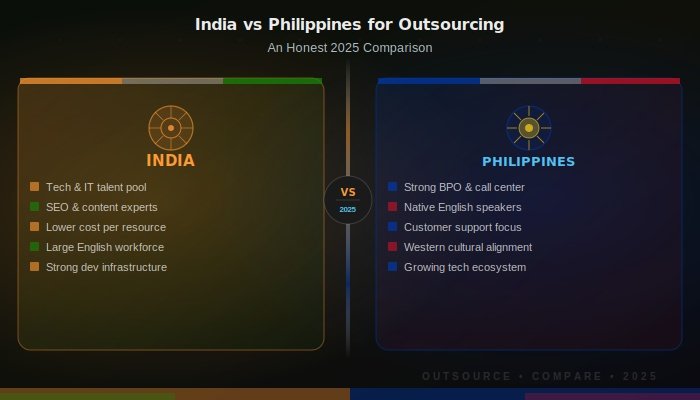
In the dynamic world of global business, outsourcing has evolved from a cost-cutting measure to a strategic imperative for growth, efficiency, and access to specialized talent. For businesses in the USA, UK, Australia, and Canada, the choice of an outsourcing destination can profoundly impact operational success. Two nations consistently emerge at the forefront of this decision: India and the Philippines. Both have robust, mature outsourcing industries, but they offer distinct advantages tailored to different business needs. This 2026 honest comparison of India vs Philippines outsourcing will delve into key factors to help you make an informed decision for your enterprise.
Choosing between these two outsourcing giants requires a nuanced understanding of their respective strengths in areas like cost-effectiveness, talent availability, cultural alignment, and technological infrastructure. As a Senior SEO Content Strategist for Marwal Enterprises, our goal is to provide a comprehensive guide that cuts through the noise and offers actionable insights for your outsourcing strategy.
Market Overview: Two Global Outsourcing Powerhouses
India and the Philippines have long dominated the global outsourcing landscape, collectively accounting for a significant majority of the market. India’s outsourcing industry, valued at over $200 billion in 2024, is the largest globally, known for its vast ecosystem of IT services, BPO, and KPO. The Philippines, while smaller at approximately $40 billion in 2024, has carved out a strong niche, particularly in customer experience management and voice-based services. Both countries are expected to maintain steady growth through 2026, with India expanding its IT and digital services footprint, and the Philippines enhancing its leadership in customer service outsourcing.
Cost-Effectiveness: Where Your Budget Goes Further
Cost efficiency remains a primary driver for outsourcing decisions, and both India and the Philippines offer competitive pricing models compared to Western countries.
Hourly Rates and Labor Costs
Traditionally, India has been known for its lower labor costs. In 2026, average hourly wages for software developers and BPO agents in India can range from $8 to $15, depending on skill and location. For roles like virtual assistants, India’s average hourly rate is around $2.70. For non-technical roles, India can be $1-$2/hour cheaper than the Philippines. This makes India a preferred choice for projects with tight budget constraints and large-scale IT projects and software development.
The Philippines, while slightly higher, offers competitive value, with similar roles typically ranging from $10 to $18 per hour. For virtual assistants, the average hourly rate is around $2.00. The total cost difference for a fully loaded offshore team member, including salary, benefits, infrastructure, and management overhead, is usually less than 15% between the two countries for non-IT roles. While India often offers lower baseline rates for software engineering and high-volume tech roles, the Philippines may cost slightly more per hour, but stronger communication and lower attrition can balance or even reduce total long-term spend.
Operational and Infrastructure Expenses
Beyond direct labor costs, businesses must consider infrastructure, management overhead, and quality-related expenses. India’s overall cost of living is generally lower, impacting labor costs and operational spending. Infrastructure costs like office space, internet, and power are comparable in major BPO cities in both nations. Ultimately, the cost comparison depends on the nature of the outsourced work and the strategic priorities of the organization.
Talent Pool & Skill Set: Matching Expertise to Your Needs
Both countries boast large, educated, English-speaking workforces and robust educational systems that produce graduates with strong technical and language skills.
India’s Technical Prowess
India’s strength lies in its massive and deep technical talent pool. With approximately 1.5 million engineering graduates annually and over 1,700 Global Capability Centers, India is a global leader in IT services, software development, application maintenance, infrastructure management, and data science. It’s the leading choice for IT outsourcing, holding 65% of the global market share. For complex technical knowledge, enterprise-level development, and high-value financial outsourcing (e.g., accounting, financial analysis), India offers a broader range of specialized talent.
The Philippines’ Communication & Service Excellence
The Philippines excels in customer experience management, voice-based services, and back-office operations. Filipino workers are known for their strong English proficiency with neutral or Western accents, making them ideal for roles requiring clear customer-facing communication, technical support, and virtual assistance. The country has a growing talent pool in software QA, mobile and web development for business apps, and application support, especially at the mid-level. The Philippines consistently shows higher employee retention rates in the BPO sector compared to India, which can lead to more stable teams and reduced retraining costs.
Cultural Compatibility & Communication: Bridging the Gap
Cultural alignment plays a crucial role in outsourcing partnerships, influencing collaboration, customer satisfaction, and operational efficiency.
Philippines: Strong Western Affinity
The Philippines benefits from a strong cultural affinity with Western countries, particularly the United States, due to historical ties and widespread exposure to American media and education. This translates into a workforce that understands Western business etiquette, humor, and customer expectations, reducing friction in client interactions. Filipino professionals consistently produce a warmer, more idiomatically Western communication style for customer-facing written communication (email, chat support, client-facing content).
India: Adaptability and Professionalism
India’s cultural landscape is diverse and dynamic, with a workforce that is highly adaptable and accustomed to global operations. While English proficiency can vary by region and role, significant strides have been made, especially in metropolitan areas and among IT professionals. Indian professionals are known for their strong professional culture, detail-orientation, and technical approach to problem-solving.
Infrastructure & Technology: The Backbone of Outsourcing
Reliable infrastructure and technological capabilities are essential for seamless outsourcing operations.
India’s Robust IT Ecosystem
India has heavily invested in state-of-the-art IT parks, technology hubs, and high-speed internet connectivity, particularly in cities like Bengaluru, Hyderabad, and Pune. The country’s extensive fiber-optic network and growing adoption of cloud computing platforms support complex IT projects and digital transformation initiatives. India offers world-class tech parks, multiple cloud regions, and strong enterprise broadband, making it a hub for cutting-edge technology and innovation.
Philippines’ Evolving Digital Landscape
The Philippines has also made significant strides in improving its infrastructure, with major outsourcing hubs in Metro Manila, Cebu, and Davao equipped with modern office spaces, high-speed internet, and disaster-resilient facilities. The government and private sector have collaborated to enhance broadband penetration and data security standards. The Philippines has shown strong connectivity in major hubs, with more than 73.6% of the population online. While India’s scale provides a broader range of specialized infrastructure, the Philippines emphasizes quality and reliability for voice-based and customer service operations.
Government Support & Business Environment: Encouraging Growth
Government support and regulatory frameworks significantly impact the ease of doing business in outsourcing destinations.
India’s Proactive Policies
India has implemented numerous reforms to attract foreign investment, including simplified tax regimes and incentives for technology startups. The country’s Digital India initiative promotes innovation and skill development, fostering a conducive environment for the IT and BPO sectors. India’s government actively supports the outsourcing industry through tax policy and regulatory infrastructure, including a unified IT services tax framework and the Digital Personal Data Protection Act (DPDP Act) enacted in 2023, with rules notified in November 2025, establishing consent-based privacy standards comparable to GDPR.
Philippines’ Targeted Incentives
The Philippines offers a business-friendly environment with policies designed to encourage foreign direct investment and ease of company registration. The government has been proactive in promoting the BPO industry, offering various incentives, including tax holidays and special economic zones (PEZA). These initiatives have contributed significantly to the rapid growth of the outsourcing sector and created a fertile ground for BPO companies to flourish.
Data Security & IP Protection: Safeguarding Your Business
Data security and intellectual property (IP) protection are paramount concerns for any business considering outsourcing.
India’s Evolving Data Protection Landscape
India’s Digital Personal Data Protection Act (DPDP Act), enacted in 2023, establishes consent-based privacy standards comparable to GDPR, providing a robust framework for data processing. India’s IT Act and CERT-In rules also govern data processing. Outsourcing service providers often hold strong security certifications like ISO 27001, SOC 2, and PCI.
Philippines’ Comprehensive Data Privacy
In the Philippines, data handling is governed by the Data Privacy Act (DPA) of 2012, enforced by the National Privacy Commission (NPC). This act sets stringent requirements on how personal data is collected, processed, stored, and shared, emphasizing lawful processing, data subject rights, and breach notifications. Cross-border data transfers are allowed with proper safeguards, which should be clearly defined in contracts. Reputable Philippine BPO providers also adhere to international security certifications.
Time Zone Differences: Maximizing Global Productivity
Leveraging time zone differences can enable a “follow the sun” approach, leading to 24/7 operations and faster project turnaround times.
Philippines: Ideal for US & Australia Overlap
The Philippines operates in the GMT+8 zone, which offers a convenient overlap with U.S. West Coast business hours and full alignment with Australian time zones. This makes it an excellent choice for companies requiring real-time communication during their business day. For Australian and UK clients, the Philippines offers significant time zone advantages, enabling daily real-time collaboration.
India: European & US East Coast Synergy
India, in GMT+5:30, provides a partial overlap with European and U.S. East Coast hours, facilitating collaboration for companies with global operations. For European companies, India has a slight timezone advantage, with a 4-5 hour difference from Western Europe allowing for more natural overlap. While both countries can align to U.S. business hours via night shifts, India offers marginally more overlap with US East Coast time.
Scalability & Flexibility: Adapting to Your Business Growth
The ability to scale operations and adapt to changing business environments is a decisive factor in choosing an outsourcing partner.
India’s Large-Scale Capacity
India’s larger population and vast talent pool allow for rapid scaling of large teams. Enterprises looking for thousands of employees across multiple departments may benefit significantly from India’s scale and breadth. India’s outsourcing industry is older and larger, offering a more mature ecosystem for large-scale digital transformation initiatives.
Philippines’ Quality-Focused Flexibility
The Philippines, while smaller in population, offers highly flexible mid-sized teams that focus on quality and long-term partnerships. If your priority is building a dedicated offshore team rather than simply outsourcing tasks, the Philippines model may feel more personalized and offer proven flexibility and scalability, especially in BPO services.
Industry-Specific Strengths: Tailoring Your Outsourcing Strategy
Outsourcing to India is Best For:
- IT Services & Software Development: India dominates in software engineering, application development, cloud computing, DevOps, cybersecurity, and data science.
- Technical Support: Strong in complex technical support roles.
- Finance & Accounting (High-Level): Excellent for financial analysis, procurement, analytics at enterprise scale, and accounting roles requiring analytical rigor.
- Back-Office Operations (Complex/Analytical): Strong in data processing, finance, and analytics at an enterprise scale.
- Virtual Assistants (Tech-Heavy/Ops-Driven): Offer a larger specialist talent pool for VAs proficient in tools like Zapier, HubSpot, QuickBooks, and custom CRM workflows.
Outsourcing to the Philippines is Best For:
- Customer Service & CX: Global leader in voice-based and chat support, with exceptional English proficiency and Western cultural alignment.
- Back-Office Operations (Communication-Heavy): Excellent for accounting, data processing, administrative, and HR operations where clear communication is key.
- Healthcare Information Management: Strong in healthcare RCM, medical billing, and virtual assistants.
- Creative & Marketing Services: Growing strengths in design, content creation, SEO/SEM, and social media management.
- Software QA & Application Support: Competitive for mid-level web development, WordPress, QA, and application support where communication reduces project management friction.
- Virtual Assistants (Voice-Heavy/Customer-Facing): Remain the stronger choice for native English fluency and customer engagement.
Key Takeaways for 2026
- Cost: India generally offers lower overall labor costs, especially for technical roles and large-scale projects. The Philippines is slightly higher but often justifies the premium with communication quality and retention.
- Talent: India boasts a massive and deep pool of IT and engineering talent, ideal for complex technical projects. The Philippines excels in customer service, back-office operations, and roles requiring strong English communication and Western cultural alignment.
- Cultural Fit: The Philippines offers a very strong cultural affinity with Western countries, leading to smoother customer interactions. India’s workforce is highly adaptable with strong professional ethics.
- Infrastructure: India has world-class IT infrastructure and diverse specialized options. The Philippines has significantly improved its digital infrastructure, emphasizing reliability for BPO hubs.
- Government Support: Both governments actively support their outsourcing industries with incentives and favorable policies. India’s DPDP Act and the Philippines’ DPA provide robust data protection frameworks.
- Time Zones: The Philippines offers excellent overlap with US West Coast and Australian business hours. India provides partial overlap with European and US East Coast hours.
- Scalability: India offers unmatched scale for large workforce expansion. The Philippines provides flexible, quality-focused mid-sized teams.
Conclusion: Your Strategic Outsourcing Partner for 2026
The India vs Philippines outsourcing debate isn’t about declaring a definitive winner; it’s about identifying the most suitable match for your company’s specific needs and strategic goals. For businesses in the USA, UK, Australia, and Canada, the optimal choice hinges on a careful assessment of your priorities. If your core need is highly technical expertise, large-scale IT development, or complex financial analysis at competitive rates, India remains a powerhouse. If, however, your focus is on exceptional customer experience, clear Western-aligned communication, reliable back-office support, or a culturally compatible dedicated team, the Philippines often presents a compelling advantage.
Many forward-thinking companies are also adopting a hybrid approach, leveraging India for their IT and development needs and the Philippines for customer service and back-office operations, thereby maximizing the unique strengths of both destinations.
Ready to Optimize Your Digital Presence?
Understanding the intricacies of global outsourcing is just one piece of the puzzle for modern businesses. At Marwal Enterprises, we specialize in crafting bespoke digital marketing strategies that drive growth, enhance online visibility, and connect you with your target audience. Whether you’re navigating the complexities of outsourcing or seeking to amplify your brand’s digital footprint, our expert team is here to help. From comprehensive SEO audits and content strategy to advanced PPC campaigns and social media management, we deliver measurable results that align with your business objectives.
Contact Marwal Enterprises today for a complimentary consultation and discover how our digital marketing services can positively impact your business in 2026 and beyond. Let’s build your success story together.