
Learn the difference between content localisation and content creation. Discover which approach overseas businesses need to engage audiences.
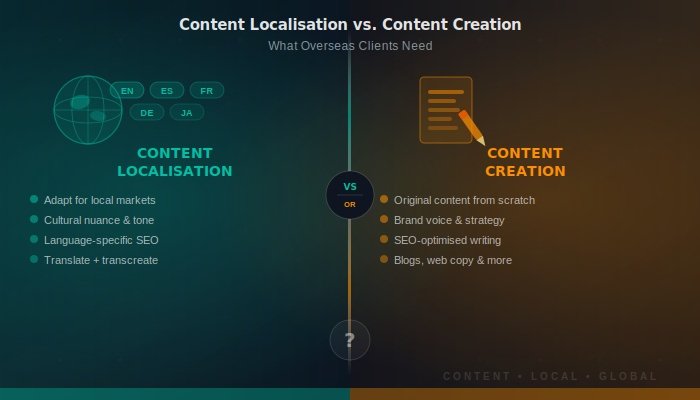
In an increasingly interconnected global economy, businesses are constantly seeking new avenues for growth and market penetration. For companies looking to expand their reach into lucrative markets such as the USA, UK, Australia, and Canada, the strategic approach to content is paramount. The question often arises: should we create entirely new content from scratch for each target market, or should we adapt and refine our existing content through a process known as content localisation? This decision is not merely a matter of semantics; it dictates marketing effectiveness, budget allocation, and ultimately, your brand’s success in diverse international landscapes. Understanding the nuances of content creation versus robust content localisation offshore is critical for any overseas client aiming for impactful global engagement.
Understanding Content Creation: Building from Scratch
Content creation, in its purest form, involves developing original material from the ground up. This encompasses everything from blog posts, articles, and website copy to videos, social media campaigns, and interactive experiences. When expanding into new territories, some businesses might instinctively opt for this route, believing a fresh start offers maximum control and relevance. While this can be a powerful strategy, it comes with its own set of considerations, especially when targeting distinct overseas markets.
What is Content Creation?
Content creation is the process of generating ideas, producing, and publishing informational or entertaining material for a specific audience. This can include a wide array of formats: textual content like articles, whitepapers, and e-books; visual content such as infographics and images; and multimedia content like podcasts, webinars, and videos. The primary goal is to engage, inform, or persuade an audience, driving them towards a desired action, be it a purchase, a sign-up, or brand loyalty. For global enterprises, this often means crafting messages that resonate with a universal brand identity while still having the flexibility to be adapted later.
When is Content Creation the Right Choice for Overseas Markets?
There are specific scenarios where developing entirely new content for offshore markets becomes the optimal strategy:
- Entering Undiscovered Niches: If your product or service is entirely new to a particular market, or if your brand has no existing presence or recognition, creating original content allows you to define your narrative from scratch. This is particularly relevant when local competitors have well-established content strategies that you cannot simply mirror or adapt.
- Unique Product Launches: For groundbreaking products or services that demand a completely new introduction, bespoke content creation ensures that every message, feature, and benefit is precisely tailored to the perceived needs and cultural context of the target audience.
- Building a Distinct Brand Voice: Sometimes, a brand’s core message or tone needs to be significantly different in a new market to achieve desired resonance. Rather than trying to force a localised version of existing content, creating new content provides the freedom to establish a unique, locally appropriate brand voice and identity.
- Addressing Specific Local Regulations or Sensitivities: Certain industries or regions, like parts of the USA or Canada, might have stringent regulatory requirements or cultural sensitivities that necessitate entirely new content to ensure compliance and avoid missteps.
Advantages of Content Creation for Offshore Expansion
- Full Control Over Messaging: Starting fresh grants complete command over the narrative, tone, and style, ensuring every element aligns with the specific market’s cultural nuances and consumer psychology.
- Tailored from Scratch: Content can be intrinsically designed to address local pain points, aspirations, and search behaviors, potentially leading to higher initial engagement.
- No Legacy Content Issues: You avoid the complexities of adapting outdated or culturally irrelevant existing content, streamlining the production process for the new market.
Challenges of Content Creation for Global Audiences
While appealing, content creation for multiple global markets poses significant hurdles:
- High Cost and Time Investment: Developing high-quality, original content for each market is resource-intensive, demanding substantial budget and time for research, writing, design, and approval processes.
- Risk of Cultural Insensitivity: Without deep local market insight, newly created content can inadvertently miss the mark, appearing tone-deaf or even offensive. This risk is particularly high when dealing with diverse cultural landscapes like those found across the USA, UK, Australia, and Canada, despite shared language.
- Requires Deep Market Research: To be effective, new content necessitates extensive, on-the-ground market research to understand local preferences, search habits, and competitive landscapes. This research is crucial for successful content localisation offshore efforts.
- Maintaining Consistency: Ensuring brand consistency across multiple, newly created content sets for different regions can be challenging.
Understanding Content Localisation: Adapting for Impact
In contrast to content creation, content localisation is the process of adapting existing content to meet the linguistic, cultural, and technical requirements of a specific target market. It goes far beyond mere translation, aiming to make content feel as though it was originally created for the local audience. This strategic approach is often the more efficient and effective path for businesses with established content seeking international growth, particularly for content localisation offshore to English-speaking markets like the USA, UK, Australia, and Canada.
What is Content Localisation?
Content localisation involves a comprehensive transformation of content, ensuring its relevance and resonance within a particular cultural context. This includes, but is not limited to:
- Linguistic Adaptation: Not just translating words, but adapting idioms, slang, humour, and tone to be natural and appropriate for the local dialect. For instance, “football” in the UK means something different than in the USA.
- Cultural Adaptation: Adjusting imagery, examples, case studies, colours, and symbols to align with local cultural norms and preferences. What works in one culture might be confusing or even offensive in another.
- Technical Adaptation: Modifying date and time formats, currency, measurement units (e.g., imperial vs. metric), legal disclaimers, and local contact information.
- Regulatory Compliance: Ensuring all content adheres to local laws and industry regulations, which can vary significantly even between culturally similar countries.
The goal is to provide a seamless, familiar, and trustworthy experience for the user, making them feel understood and valued.
Why is Content Localisation Crucial for Offshore Success?
For businesses targeting overseas markets, robust content localisation offers a multitude of benefits:
- Resonance with Local Audiences: Localised content speaks directly to the target audience in a way that generic or simply translated content cannot, fostering a deeper connection and emotional engagement.
- Improved User Experience and Engagement: When content feels natural and relevant, users are more likely to spend more time on your site, engage with your materials, and convert. Studies show that a significant percentage of consumers prefer to buy from websites in their native language.
- Compliance with Local Regulations: Proper localisation ensures that your content meets legal and industry-specific requirements, mitigating risks and building trust.
- Significant SEO Benefits: Content localisation offshore is critical for improving search engine rankings in target markets. It involves optimising content for local keywords, search terms, and search engine algorithms, leading to increased organic traffic.
- Building Trust and Credibility: By demonstrating an understanding and respect for local culture and language, brands build greater trust and credibility, which are essential for long-term customer loyalty.
- Competitive Advantage: Businesses that excel at content localisation stand out from competitors who rely on a one-size-fits-all approach, gaining a significant edge in the market.
The Nuances of Content Localisation Offshore for USA, UK, Australia, and Canada
Even within English-speaking countries, the need for precise content localisation offshore is evident. While they share a common language, significant differences exist in vocabulary, spelling, grammar, idioms, and cultural references that can impact content effectiveness. For example:
- Spelling and Vocabulary: “Color” (US) vs. “Colour” (UK, AU, CA), “tire” (US) vs. “tyre” (UK, AU), “trunk” (US) vs. “boot” (UK, AU), “sweaters” (US) vs. “jumpers” (UK, AU).
- Idioms and Phrases: A phrase that is common and understood in the UK might be completely foreign or even confusing in the USA.
- Date and Time Formats: DD/MM/YYYY (UK, AU, CA) vs. MM/DD/YYYY (US).
- Measurement Units: Imperial units are still prevalent in the USA for certain contexts, while the UK, Australia, and Canada predominantly use the metric system.
- Cultural References: Humor, sports references, political contexts, and historical events vary widely and must be adapted to resonate appropriately.
- Legal and Consumer Protection Language: Specific phrasing and disclosures might be required by law in one country but not another.
Ignoring these nuances can lead to content that feels unnatural, unprofessional, or simply irrelevant to the local audience, hindering your global marketing efforts.
Advantages of Content Localisation for International Growth
- Cost-Effective: Localising existing high-performing content is often more cost-effective and time-efficient than creating entirely new content from scratch for each market.
- Faster Market Entry: Leveraging existing content allows for quicker adaptation and deployment, accelerating your time to market in new regions.
- Leveraging Proven Content: You can adapt content that has already demonstrated success in your home market, increasing the likelihood of positive reception abroad.
- Enhanced Brand Perception: A localised approach demonstrates that your brand values and understands its international customers, strengthening global brand loyalty.
Potential Pitfalls of Poor Content Localisation
Conversely, ineffective content localisation can be detrimental:
- Embarrassing Errors: Direct translation without cultural adaptation can lead to awkward, nonsensical, or even offensive content, severely damaging brand reputation.
- Loss of Meaning: Nuances and intended meanings can be lost in translation if not handled by linguists with deep cultural understanding.
- Alienating the Target Audience: Content that clearly hasn’t been adapted for a local audience can make customers feel undervalued and disrespected, leading to low engagement and high bounce rates.
- Damaging Brand Reputation: A series of localisation failures can erode trust and make it difficult to establish credibility in a new market.
The Strategic Intersection: When to Localise, When to Create
The most effective global content strategy often involves a thoughtful blend of both content creation and content localisation offshore. It’s rarely an either/or proposition but rather a strategic decision based on specific market conditions, content goals, and available resources.
Hybrid Approaches to Content Localisation Offshore
Many successful global brands adopt a hybrid model:
- Core Message Creation, Then Localisation: Develop foundational, high-level content in a source language (often English) that encapsulates the brand’s core message. This content is then meticulously localised for each target market, adapting it culturally and linguistically. This ensures consistency in core messaging while allowing for local relevance.
- Localised Content Hubs: Establish regional content hubs that can both localise global content and create entirely new content addressing highly specific local trends, events, or customer needs. This balance allows for both scalability and deep market immersion.
- AI-Powered Localisation with Human Oversight: Leveraging advanced AI translation tools for efficiency in initial translation and technical adaptation, followed by expert human linguists and cultural reviewers to refine and ensure cultural appropriateness and brand voice. This hybrid approach to content generation is gaining significant traction in 2026 for its efficiency and quality.
Key Factors in Your Decision-Making Process
To determine the optimal strategy for your overseas clients, consider these factors:
- Target Market Maturity: For highly mature markets with established competitors and specific consumer expectations (e.g., USA, UK), a nuanced content localisation offshore approach is often more effective than starting from scratch. For nascent markets, new content might be necessary to educate and build awareness.
- Budget and Timeline: Content creation is typically more expensive and time-consuming. Localisation, especially of existing high-performing content, can offer a faster and more economical route to market.
- Existing Content Assets: Evaluate the quality and relevance of your current content. If you have a robust library of successful content, localisation is a clear advantage. If your existing content is minimal or outdated, creating new content might be more beneficial.
- Brand Goals and Desired Impact: Are you aiming for broad brand awareness or specific conversions? Localisation excels at driving conversions and building trust by speaking directly to local preferences.
- Competitive Landscape: Analyze what your competitors are doing in target markets. If they are successfully localising, you likely need to do the same to compete effectively.
The Role of SEO in Global Content Strategy
Regardless of whether you choose creation or localisation, SEO is a non-negotiable component of any successful global content strategy. For content localisation offshore, SEO becomes even more intricate, requiring a deep understanding of local search behaviors and technical considerations.
- Local Keyword Research: This is paramount. Simply translating keywords often yields poor results because search terms and user intent vary significantly across cultures and regions, even within the same language. Extensive research into local search trends, synonyms, and phrasing is essential for effective content localisation.
- Technical SEO for International Sites: Implementing correct hreflang tags, choosing appropriate URL structures (ccTLDs, subdomains, or subfolders), and geo-targeting signals search engines which content is intended for which audience, preventing duplicate content issues and ensuring the right version appears in local search results.
- Optimising Localised Content for Search Engines: Beyond keywords, this involves localizing meta titles, descriptions, image alt texts, and ensuring site speed and mobile-friendliness for regional users. Local link building strategies, engaging with local influencers and websites, also contribute significantly to localised SEO success.
Partnering for Success: Expert Content Localisation Offshore
Navigating the complexities of global content strategy requires specialized expertise. The decision to create new content or embark on comprehensive content localisation offshore demands a partner who understands not only linguistic accuracy but also cultural nuances, market dynamics, and advanced SEO techniques across diverse regions like the USA, UK, Australia, and Canada. A skilled digital marketing agency can help you assess your existing content, identify the most promising markets, develop a tailored strategy, and execute content initiatives that resonate deeply with your target audience, driving measurable results.
Working with experts ensures that your content is not just translated, but truly transformed to connect with local consumers, build lasting trust, and achieve your international business objectives. They can provide the necessary market insights, linguistic proficiency, and technical SEO acumen to make your global expansion a resounding success.
Key Takeaways
- Content creation involves developing original material from scratch, best suited for new market entries or unique product launches.
- Content localisation is the adaptation of existing content to fit the linguistic, cultural, and technical requirements of a specific target market, going beyond mere translation.
- For overseas clients in the USA, UK, Australia, and Canada, content localisation offshore is crucial due to significant differences in spelling, vocabulary, idioms, cultural references, and regulatory requirements, even within the English language.
- Effective content localisation leads to increased market reach, improved user experience, higher engagement and conversion rates, stronger brand loyalty, and a competitive advantage.
- A hybrid strategy, combining core content creation with meticulous localisation, often yields the best results for global expansion, especially when supported by AI and human expertise.
- Robust SEO, including local keyword research, technical international SEO, and on-page optimization for localised content, is essential for visibility and success in global markets.
- Partnering with experienced digital marketing professionals is key to navigating the complexities of global content strategy and ensuring effective content localisation offshore.
Ready to Master Your Global Content Strategy?
Expanding your business across international borders, particularly into competitive markets like the USA, UK, Australia, and Canada, demands a sophisticated and nuanced approach to content. Whether your needs lean towards strategic content creation or impactful content localisation offshore, Marwal Enterprises is your trusted partner in navigating these complexities. Our team of Senior SEO Content Strategists specializes in crafting and adapting digital content that not only ranks high in local search results but also deeply resonates with your target audience.
Don’t let linguistic barriers or cultural misunderstandings hinder your global ambitions. Marwal Enterprises offers comprehensive digital marketing services, including bespoke content development, advanced SEO localisation, and strategic guidance to ensure your brand speaks directly to the hearts and minds of your overseas clients. Let us help you unlock new markets, drive engagement, and achieve unparalleled international growth.
Connect with Marwal Enterprises today to discuss your global content needs and discover how our expertise can accelerate your international success.