
Here’s a detailed guide to the digital marketing funnel, designed to help you understand each stage and achieve business growth. From awareness to loyalty, each stage is thoroughly explained.
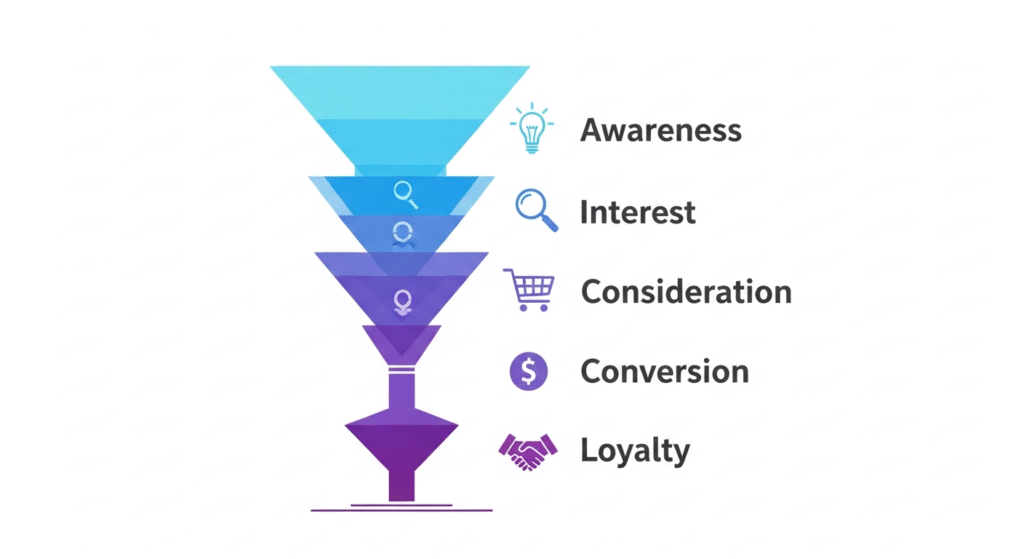
The digital marketing funnel represents the customer journey from initial brand awareness to becoming a loyal advocate. Understanding and optimizing each stage of this funnel is crucial for businesses seeking sustainable growth in 2025.
What Is a Digital Marketing Funnel?
A digital marketing funnel is a strategic framework that visualizes the path potential customers take from discovering your brand to making purchases and becoming repeat buyers. Unlike traditional linear models, modern funnels recognize that customer journeys are complex, with multiple touchpoints across various channels.
The Five Essential Stages of the Digital Marketing Funnel
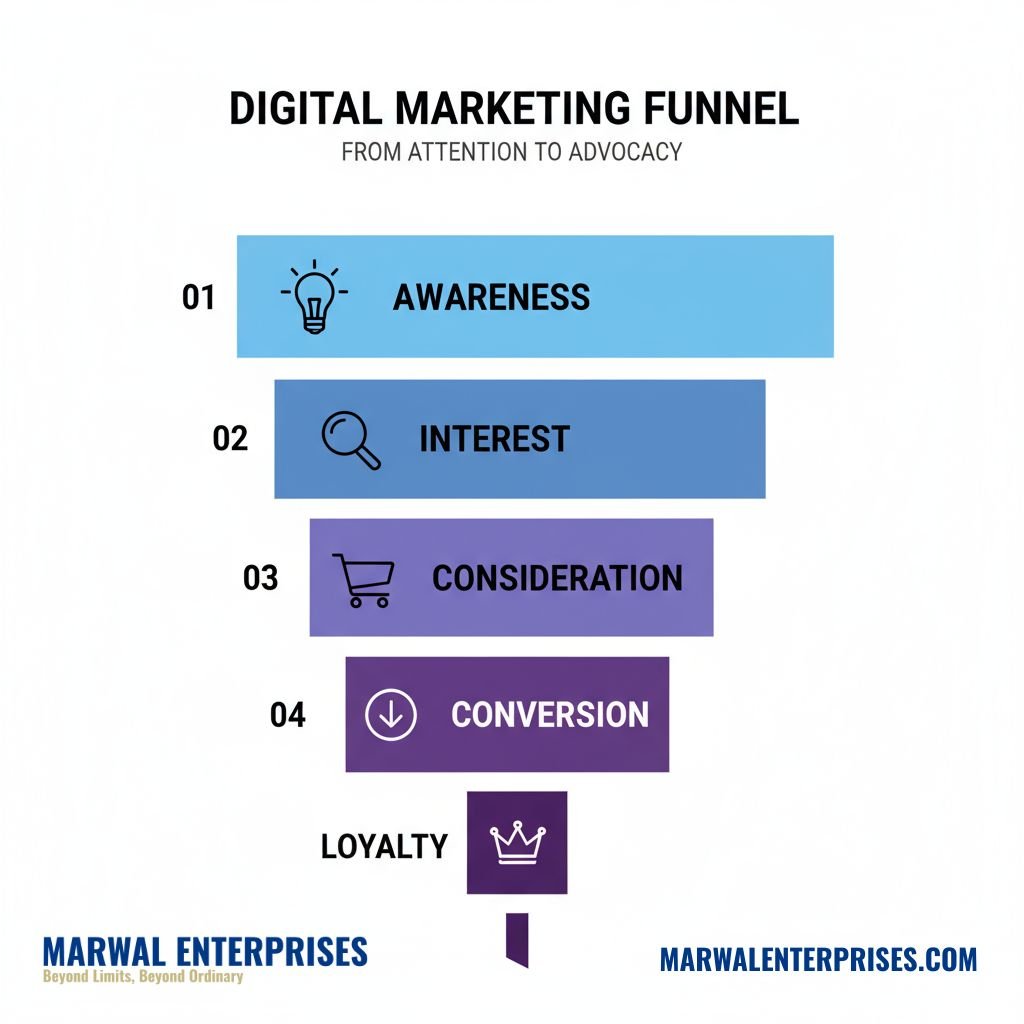
Awareness Stage: Building Brand Recognition
The awareness stage focuses on capturing attention and introducing your brand to potential customers who may not yet know they have a problem you can solve. At this stage, prospects discover your business through search engines, social media advertisements, content marketing, or word-of-mouth recommendations.
Effective awareness strategies include search engine optimization to appear in relevant searches, social media advertising campaigns targeting specific demographics, content marketing through blogs and videos that address common industry questions, and influencer partnerships to reach established audiences.
Interest Stage: Engaging Potential Customers
Once awareness is established, potential customers enter the interest stage, where they actively seek more information about solutions to their problems. They may visit your website multiple times, subscribe to your newsletter, follow your social media accounts, or download free resources like ebooks or whitepapers.
To nurture interest effectively, provide valuable educational content that demonstrates expertise without aggressive selling, offer lead magnets such as free guides or tools in exchange for contact information, create engaging email sequences that provide ongoing value, and develop comparison content that positions your solution favorably.
Consideration Stage: Building Trust and Preference
During the consideration stage, prospects actively evaluate different solutions and compare various providers. They read reviews, watch product demonstrations, request quotes, and engage with customer service to assess whether your offering meets their needs.
Winning strategies for this stage include detailed case studies showcasing successful customer outcomes, product demonstration videos highlighting key features and benefits, customer testimonials and reviews that build social proof, webinars or consultations offering personalized guidance, and comparison charts demonstrating your competitive advantages.
Conversion Stage: Turning Prospects into Customers
The conversion stage represents the moment when a prospect decides to become a paying customer. This critical juncture requires removing all friction from the purchasing process and providing compelling reasons to choose your solution immediately rather than delaying the decision.
Conversion optimization tactics include streamlined checkout processes with minimal required fields, multiple payment options to accommodate different preferences, time-limited offers creating urgency, free trials or money-back guarantees reducing perceived risk, and live chat support addressing last-minute concerns.
Loyalty Stage: Creating Repeat Customers and Advocates
The funnel does not end with a single purchase. The loyalty stage focuses on delighting customers to encourage repeat business and transform satisfied buyers into brand advocates. Research shows that retaining existing customers costs significantly less than acquiring new ones, making this stage critical for sustainable profitability.
Loyalty-building initiatives include exceptional customer service exceeding expectations, loyalty programs rewarding repeat purchases, exclusive content or offers for existing customers, regular communication through personalized emails, and referral programs incentivizing customer advocacy.
Implementing Your Digital Marketing Funnel Strategy
Step 1: Define Your Target Audience
Success begins with a deep understanding of who you serve. Create detailed buyer personas including demographic information, pain points and challenges, goals and aspirations, preferred communication channels, and decision-making processes.
Step 2: Map Your Customer Journey
Document the typical path customers take from problem awareness to purchase and beyond. Identify all potential touchpoints where prospects interact with your brand, recognize common obstacles preventing progression between stages, and determine key metrics for measuring success at each stage.
Step 3: Create Stage-Specific Content
Develop content tailored to each funnel stage. Top-of-funnel content should focus on education and problem identification through blog posts addressing common questions, infographics explaining industry concepts, and social media content building brand personality.
Middle-of-funnel content emphasizes solution evaluation through detailed guides comparing different approaches, email sequences nurturing leads over time, and webinars demonstrating expertise and product capabilities.
Bottom-of-funnel content drives conversion through product demos showcasing specific features, customer success stories proving real-world results, and limited-time offers creating urgency.
Step 4: Implement Tracking and Analytics
Measurement enables optimization. Establish key performance indicators for each stage, including website traffic and cost per visitor for awareness, email open rates and content downloads for interest, demo requests and quote submissions for consideration, conversion rate and average order value for conversion, and repeat purchase rate and customer lifetime value for loyalty.
Step 5: Optimize Continuously
Digital marketing funnels require ongoing refinement. Analyze performance data regularly to identify bottlenecks where prospects drop off, test different approaches through controlled experiments, gather customer feedback to understand pain points, and stay current with evolving customer expectations and the competitive landscape.
ALSO READ: Leveraging Data Analytics for Business Growth
Common Digital Marketing Funnel Mistakes to Avoid
Many businesses sabotage their funnel effectiveness through preventable errors. Avoid focusing exclusively on acquisition while neglecting retention and loyalty, creating generic content that fails to address specific stage needs, implementing tracking systems inadequately, preventing data-driven optimization, expecting immediate results rather than allowing time for funnel maturation, and ignoring mobile optimization despite increasing mobile shopping prevalence.
Advanced Funnel Optimization Strategies
Segmentation and Personalization
Generic messaging reduces effectiveness. Segment your audience based on demographics, behavior patterns, purchase history, and engagement levels to deliver personalized experiences that resonate more deeply.
Marketing Automation
Technology enables scalability. Implement automation tools to deliver timely, relevant communications without manual intervention. Automated email sequences can nurture leads efficiently, while chatbots provide instant support during consideration phases.
Retargeting Campaigns
Most visitors do not convert on their first interaction. Retargeting advertisements remind prospects about your solution as they browse other websites, keeping your brand top-of-mind during their decision-making process. Studies show retargeting can increase conversion rates significantly by reaching prospects already familiar with your brand.
A/B Testing Everything
Assumptions lead to suboptimal results. Test variations of headlines, call-to-action buttons, page layouts, email subject lines, and pricing presentations to identify what resonates most effectively with your audience.
Measuring Funnel Performance
Success requires quantification. Track conversion rates between each stage to identify where prospects exit your funnel prematurely. Calculate customer acquisition cost by dividing total marketing expenses by the new customers acquired. Determine customer lifetime value to understand long-term relationship profitability. Monitor time-to-conversion to identify whether your sales cycle is lengthening or accelerating. Analyze channel performance to allocate budget toward the highest-performing traffic sources.
The Future of Digital Marketing Funnels
Marketing funnels continue evolving with technological advancements and changing consumer behaviors. Artificial intelligence enables hyper-personalization at scale, predicting individual customer needs and preferences. Voice search optimization becomes increasingly important as smart speakers proliferate in homes. Video content dominates consumer preferences, requiring funnel strategies incorporating this medium at every stage. Social commerce integration allows purchases to be made directly within social platforms, compressing funnel stages. Privacy-focused marketing adapts to increasing consumer demand for data protection and regulatory requirements.
The digital marketing funnel remains fundamental to business growth, providing structure for attracting strangers and converting them into loyal customers. By understanding each stage, creating appropriate content, measuring performance, and optimizing continuously, businesses can build sustainable growth engines that consistently deliver qualified leads and satisfied customers. Implementation requires patience and persistence, but companies mastering their funnel gain significant competitive advantages in crowded marketplaces.
ALSO READ: The Importance of SEO in Modern Business: A Comprehensive Guide For 2025